Auction House or Gallery? Positioning in the Secondary Market
Auction House or Gallery? Positioning in the Secondary Market
When a collector decides to sell a work, or an heir has to evaluate a collection, the first question that comes up is usually the wrong one: "Who will pay the highest price?" The right question is this: for this particular work, this artist, and this moment, which channel — auction house or gallery — provides the right positioning? These two channels don't do the same job in different ways; they represent different risks, different time horizons, and different logics of reputation.
Distinguishing the primary market from the secondary market
The primary market is the setting in which a work is offered for sale for the first time: typically the artist's own gallery, an art fair booth, or a studio sale. The price is set between the gallery and the artist, and it becomes the "official" reference point for the market.
The secondary market, on the other hand, is any setting in which a work that has already changed hands is offered for resale — an auction room, a private sale, a secondary-market gallery, or a direct transaction between collectors. Here, the price is no longer set by the artist or the primary gallery, but by supply and demand. This is exactly where the question of positioning begins: someone selling in the secondary market has to decide through which mechanism they want the value they hold to be revealed.
The auction house: speed, transparency, competition
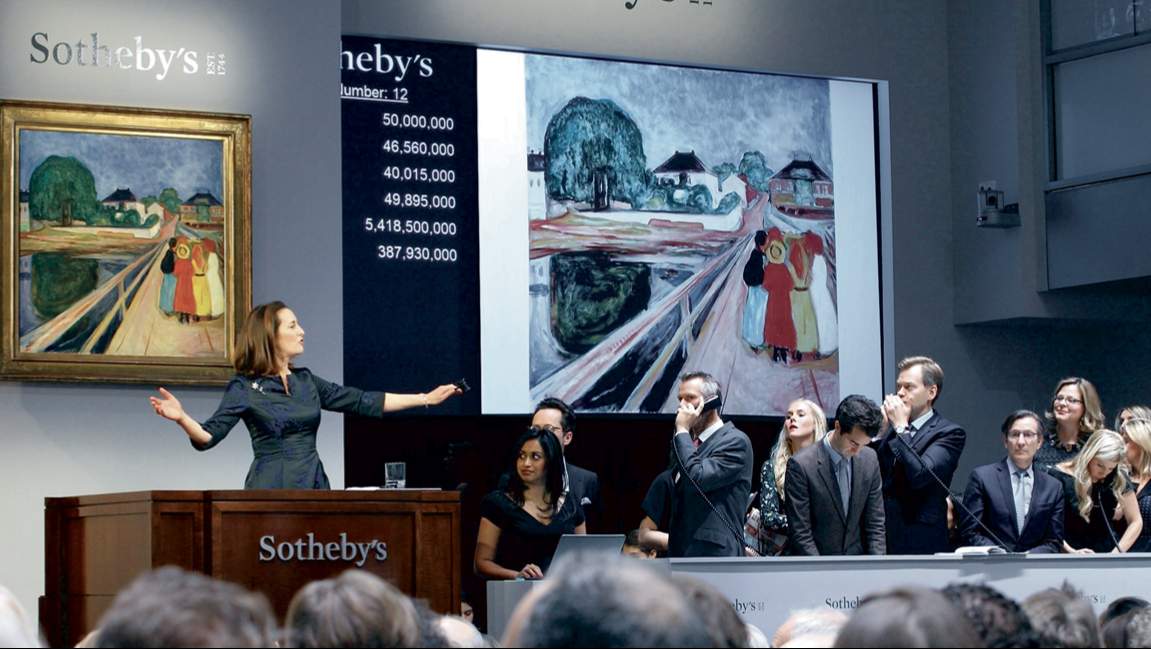
The core value an auction house offers is "price discovery": multiple buyers competing for the same work at the same time publicly reveals its true market value at that moment. This transparency cuts both ways — for the seller (a result above the estimate is possible) and for the market (the resulting price becomes a reference for future valuations and can become an "auction record").
Auction houses also offer speed and certainty: on a given date, in a given room, the sale either happens or it doesn't. This is a real advantage in situations under time pressure, such as an estate liquidation, an inheritance settlement, or a need for liquidity.
But this transparency comes at a cost: if a work falls below its estimate or receives no bids at all (referred to as being "burned" or "bought in"), this is recorded publicly and can negatively affect how the market perceives the work in the future.
For this reason, auction houses are generally a safer ground for works by artists who have already attracted institutional interest and have a solid provenance record — names the market already has a view on benefit the most from the competitive dynamics of an open auction.
The gallery: curation, relationships, discretion
The gallery model works on a different logic: the price is set not through open competition but through the gallery's network of collectors, curatorial authority, and negotiating skill. Sale prices are generally not disclosed publicly; this discretion protects both the buyer and the seller from unfavorable public perception.
One of the most critical functions galleries perform in the secondary market is protecting the artist's career. If a work by an emerging or mid-career artist sells below expectations at auction, that single event can overshadow the artist's entire market for years. Galleries manage this risk by steering the work toward the right collector — often someone with the potential to donate it to a museum, or someone who will hold it for the long term.
The cost of this approach is speed: finding the right buyer can take weeks, sometimes months, and the gallery typically charges a higher commission.
Criteria for positioning
In practice, the positioning decision is shaped along three axes: the market maturity of the work or the artist, the seller's need for time and discretion, and their tolerance for reputational risk.
As a general tendency, the following can be said:
- Works by artists who have already attracted institutional interest are better suited to auction; emerging or mid-career artists are better protected by a gallery.
- If liquidity and speed matter most, auction is preferable; if there is flexibility to wait for the right buyer, a gallery is preferable.
- If public price discovery is desired, auction stands out; if price discretion matters, a gallery stands out.
- If the risk of the work not selling is acceptable, auction works; if a public failure cannot be tolerated, a gallery is the safer route.
These tendencies are not absolute rules. The same work, at a different time or in a different collecting context, could just as easily go through the opposite channel.
Hybrid models: the line is increasingly blurred
Over the past two decades, major auction houses have absorbed tools that once belonged to the gallery's logic. "Private sale" departments sell a work through one-on-one, gallery-style negotiation without putting it up for open auction — combining the auction house's global buyer network with the gallery's discretion and flexibility.
Likewise, "guarantee" mechanisms — in which the auction house or a third party guarantees the seller a minimum amount even if the work fails to sell — reduce the auction's biggest risk, the risk of not selling, with a gallery-like assurance. In turn, major galleries are now setting up their own secondary-market desks, taking on resale transactions once left solely to auction houses.
As a result, the question of "auction house or gallery" is no longer a binary choice but a matter of positioning along a spectrum. Sophisticated sellers may move a single work through different tools along this spectrum in sequence — for example, a quiet round of offers through a gallery first, followed by auction if needed.
Conclusion: positioning is a matter of timing
The choice between an auction house and a gallery is not a verdict on which one is "better." One sells transparency and speed; the other sells relationships and protection. The right question isn't "which one," but "which mechanism carries the right risk for this work, this artist, this collector, right now." True mastery in the secondary market lies in being able to use these two logics in sequence to complement each other, rather than pitting them against one another.
This article is for general informational purposes only and is not a substitute for investment or legal advice regarding any specific work or sale decision.